

Warehousing & Logistics Industry Insights
The essentials every logistics and supply-chain professional should know.
Service
Description
From dock layout to floor strength, each design choice affects how efficiently goods can flow. Understanding these fundamentals helps match your operations to the right facility. Here you’ll find a concise reference for the standards shaping modern warehousing.
DIFFERENT TYPES OF WAREHOUSE GRADES
Warehouses are classified into grades to help define the quality, performance, and suitability of a facility for different types of operations. A higher grade reflects modern design, strong safety standards, and greater efficiency, while lower grades suit slower-moving or less specialised storage needs. The following overview explains what each grade means and what to expect from the facilities within it.
The highest industrial standard. Grade A facilities are built for efficiency, safety, and modern logistics requirements.
Typical characteristics:
- 10–15 m clear height
- Wide column spacing (12–15 m grids)
- Strong floor load capacity (3–5 tons/m²)
- Multiple loading docks with dock levellers
- Enhanced fire safety (ESFR sprinklers, smoke vents)
- Energy-efficient features such as LED lighting and solar-ready roofing
- Suitable for automation, high-bay racking, and advanced WMS integration
Grade A facilities represent modern logistics design standards, typically offering higher clear heights, stronger floors, enhanced fire safety systems, and energy-efficient features.
Well-built but older or with fewer modern features.
Typical characteristics:
- 8–10 m clear height
- Adequate floor load capacity
- Fewer docks and less efficient loading areas
- Moderate energy efficiency
Suitable for bulk storage, non-time-critical operations, or sectors with lower throughput.
Basic storage facilities with limited design optimisation.
Typical characteristics:
- Lower clear heights
- Basic loading access
- Limited temperature control and fire-safety measures
Often used for long-term storage, secondary inventory, or materials that don’t require fast rotation.
Basic storage facilities
Typical Characteristcs:
- Non-standard structures
- Minimal performance features.
- Suitable for low-value, non-hazardous goods
- Limited performance standards beyond basic regulatory compliance.
DIFFERENT WAREHOUSE TYPES
Different warehouse types are designed to serve separate roles in the supply chain. Some focus on speed and throughput, others on compliance or temperature control, and others on long-term or bulk storage. Understanding these distinctions makes it easier to match what you need with the right facility and avoid unnecessary cost or complexity.
Bonded warehouses operate under customs control, allowing imported goods to be stored without paying duties or VAT until they enter the local market. These facilities are ideal for re-exporters, traders, and businesses that want to improve cash flow by deferring duties. Goods can be re-exported directly from the bonded zone without local customs charges.
Distribution centres are designed for fast-moving, high-throughput operations where goods must be received, sorted, and dispatched quickly. They typically feature multiple loading docks, efficient layout planning, and strong road and port connectivity. DCs support sectors such as retail, FMCG, and industrial distribution where timing and accuracy matter.
Cold storage facilities provide temperature-controlled environments for chilled, frozen, or sensitive goods such as food, FMCG, and pharmaceuticals. They typically support operations that must comply with SFDA regulations and GDP requirements, subject to operator licensing.
E-commerce fulfilment centres are built for high picking rates, rapid order processing, and returns handling. They often feature mezzanine levels, automation compatibility, and value-added service areas for packing and labelling. These centres support online retailers, marketplaces, and last-mile distribution networks.
Build-to-Suit facilities are custom-designed and constructed around specific operational needs. They allow businesses to define clear heights, loading dock requirements, temperature zones, office integration, and technical infrastructure. BTS is suited to tenants with long-term planning horizons or specialised workflows.
Pre-built warehouses are standardised, ready-to-lease units designed for faster operational start-up which are designed for rapid operational start-up. They offer Grade-A specifications such as high clearances, strong flooring, dock levellers, and integrated offices. These facilities are ideal for businesses needing immediate space without the lead time of custom construction.

Key Warehouse Design Features
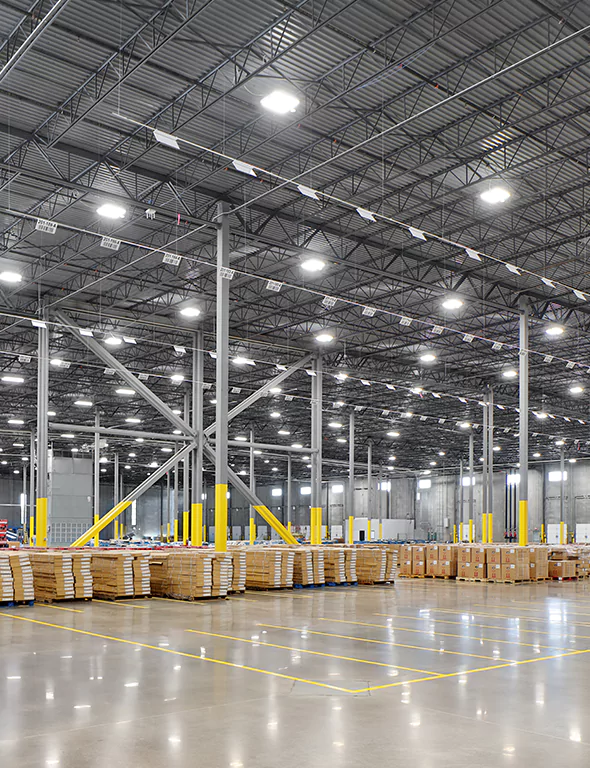
The performance of any warehouse depends on the way it is designed and the features within it. Structural elements such as clear height, floor strength, loading access and fire safety determine how efficiently goods can move, how safely they can be stored, and how well the facility supports automation or high-volume operations. These are the core features to understand when evaluating any modern warehouse.
Clear height is the usable vertical space inside a warehouse. Grade A facilities typically offer 10–15 metres, allowing for high racking, greater pallet density and smoother integration with automation or mezzanine systems.
Floor load capacity measures how much weight the warehouse floor can safely support. Modern logistics buildings usually offer 3–5 tons/m², which is essential for heavy goods, machinery, forklifts and high-bay racking.
Column spacing affects how easily racking, equipment and flow lanes can be arranged. Grade A facilities often use 12–15 metre grids, giving greater flexibility and allowing efficient movement of people and goods.
Docks are critical for receiving and dispatching goods. Modern facilities offer multiple dock doors with dock levellers, wide turning radii and separate access points for trucks and small vehicles.
Fire safety is a key requirement for warehouse compliance. Grade A standards often incorporate advanced fire protection systems such as ESFR sprinklers, smoke ventilation, and fire-rated construction, smoke vents, fire-rated walls, and clear emergency access routes. These features protect people, goods, and infrastructure while supporting insurance and regulatory requirements.
Temperature and airflow management help maintain product integrity, particularly for food, pharmaceuticals and sensitive materials. Warehouses may range from ambient to chilled or frozen conditions, depending on their purpose. Proper ventilation also improves worker comfort and equipment performance.
Sustainability features such as LED lighting, motion sensors, insulated roofing and solar-ready structures reduce operating costs and improve environmental performance. These elements are increasingly part of modern logistics design and are aligned with Vision 2030 sustainability objectives
Automation-ready warehouses include features such as smooth flooring, high clear heights, smart grid layouts, and infrastructure for WMS, robotics or ASRS systems. Designed to support automation, robotics, and advanced warehouse management systems where required
Pre-Built vs Build-to-Suit Warehousing
The choice between pre-built and build-to-suit warehouses comes down to balancing a company’s timelines, operational needs and long-term plans. Pre-built units prioritise speed and flexibility, while build-to-suit facilities offer customisation and control. The table below highlights the main differences to help businesses choose the option that fits their strategy.
Criteria | Pre-Built Facilities | Build-to-Suit Facilities |
| Speed to Occupy | Immediate; ready to lease and operate | Longer lead time; design and construction required |
| Customisation | Limited to existing layout and infrastructure | High; tailored to operational flow and specifications |
| Upfront Investment | Low; no construction cost | Higher complexity; involves planning, design, and construction |
| Flexibility | Good for short-term or changing needs | Best for long-term, stable operations |
| Design Standards | Grade-A features such as high clear heights, strong floors, dock levellers, integrated offices | Fully customisable; choose clear height, docks, utilities and automation readiness |
| Scalability | Add more units as needed | Scalable but tied to construction timeline and planned footprint |
| Ideal Use Cases | Fast market entry, seasonal peaks, contract wins, standard storage | Specialised processes, automation, long-term leases, sector-specific needs |
| Risk & Control | Lower risk; shared building standards | Full control over design, operations and efficiency |
Warehouse Evaluation Checklist
Choosing the right warehouse requires more than checking the size and the lease rate. The best facilities support faster movement, safer storage, and long-term efficiency. This checklist highlights the core factors every business should evaluate when comparing warehouse options.
- How close is the warehouse to ports, highways, airports or consumption centres?
- Will the location reduce transport time, waiting time, and overall logistics cost?
- Are there truck restrictions or access limitations that could affect operations?
- Does the warehouse meet your requirements (clear height, docks, floor load, spacing)?
- Is the structure modern, well maintained, and compliant with local regulations?
- How many loading docks are available, and are they equipped with dock levellers?
- Is there enough apron and turning space for trucks?
- Can the layout support peak traffic and high-throughput operations?
- Is the floor load suitable for your goods, equipment, and storage systems?
- Can the space accommodate high-bay racking or automation if needed?
- Are fire systems up to ESFR or equivalent standards?
- Are fire exits, hydrants, sprinklers and smoke vents appropriately placed?
- Does the facility meet the compliance requirements for your products?
- Does the warehouse provide the temperature range your products require?
- Is ventilation adequate for workers, equipment and product stability?
- For cold chain does the facility support temperature monitoring and backup systems?
- Is the site fenced, gated and monitored 24/7?
- Are CCTV cameras, access control and security personnel available?
- Can you expand within the facility or the wider logistics park if needed?
- Are there adjacent open yards or additional units available for growth?
- Is the lease flexible enough to match future demand?
- Is on-site maintenance available for repairs and upkeep?
- Are MHE rentals, fuel access, weighbridges, and utilities available on site or through approved providers?
- Are value-added services (palletising, labelling, kitting) available if required?
- Are lease terms short-term, long-term, or mixed?
- Are there service charges, utilities, or hidden operating costs?
- Does the facility offer bonded options to defer duties/VAT if relevant?
- Does the building support WMS, scanners and real-time data systems?
- Is the design compatible with automation or robotic equipment?
- Is connectivity robust across the entire warehouse?
Get In Touch
What do you need?
Let’s build your logistics future together.
Email
info@LogiPoint.sa
Social network
Head Office
P.O. Box 23242,
Jeddah 21426 KSA
Call us today
+966 12 648 8144

